Showing posts with label Science. Show all posts

Saturday, June 29, 2013

Global Science June 2013

Global Science is a Pakistan' s Largest circulated popular monthly science magazine in Urdu. The magazine has been in publication since January 1998. In the early years, the magazine gained popularity among the students especially by publishing IT-related articles in Urdu. However, issues now cover more diverse topics, including medicine, astrophysics, the defence industry and nanotechnology along with IT. The editorial team comprises Aleem Ahmed as the Chief Editor, Waseem Ahmed as the Managing Editor and a number of writers including Suhail Yousuf, Tafseer Ahmed, Zeeshan-ul-hassan Usmani and Malik Muhammad Shahid Iqbal Prince.This Magazine has a lot of subjects like computer, laptops, Softwares, Window, Linux and other science related topics.  Download below Global Science Urdu Magazine May 2013..... 
or

Thursday, June 20, 2013

Global Science April 2013


Download (13 Mb File)
or
Read Online


Download (3 Mb File)
or

Book. Global Science May 2013. Free Download or Read Online

Global Science is a Pakistan' s Largest circulated popular monthly science magazine in Urdu. The magazine has been in publication since January 1998. In the early years, the magazine gained popularity among the students especially by publishing IT-related articles in Urdu. However, issues now cover more diverse topics, including medicine, astrophysics, the defence industry and nanotechnology along with IT. The editorial team comprises Aleem Ahmed as the Chief Editor, Waseem Ahmed as the Managing Editor and a number of writers including Suhail Yousuf, Tafseer Ahmed, Zeeshan-ul-hassan Usmani and Malik Muhammad Shahid Iqbal Prince.This Magazine has a lot of subjects like computer, laptops, Softwares, Window, Linux and other science related topics.  Download below Global Science Urdu Magazine May 2013..... 
 
 
Download (14 Mb)
or

Tuesday, May 7, 2013

Global Science April 2013

Global Science is a Pakistan' s Largest circulated popular monthly science magazine in Urdu. The magazine has been in publication since January 1998. In the early years, the magazine gained popularity among the students especially by publishing IT-related articles in Urdu. However, issues now cover more diverse topics, including medicine, astrophysics, the defense industry and nanotechnology along with IT. The editorial team comprises Aleem Ahmed as the Chief Editor, Waseem Ahmed as the Managing Editor and a number of writers including Suhail Yousuf, Tafseer Ahmed, Zeeshan-ul-hassan Usmani and Malik Muhammad Shahid Iqbal Prince.This Magazine has a lot of subjects like computer, laptops, Software, Window, Linux and other science related topics.  Download below Global Science Urdu Magazine April 2013


Download (13 Mb File)
or
Read Online


Download (3 Mb File)
or

Monday, April 22, 2013

Global Science February 2013

Global Science is a Pakistan' s Largest circulated popular monthly science magazine in Urdu. The magazine has been in publication since January 1998. In the early years, the magazine gained popularity among the students especially by publishing IT-related articles in Urdu. However, issues now cover more diverse topics, including medicine, astrophysics, the defence industry and nanotechnology along with IT. The editorial team comprises Aleem Ahmed as the Chief Editor, Waseem Ahmed as the Managing Editor and a number of writers including Suhail Yousuf, Tafseer Ahmed, Zeeshan-ul-hassan Usmani and Malik Muhammad Shahid Iqbal Prince.This Magazine has a lot of subjects like computer, laptops, Softwares, Window, Linux and other science related topics.  Download below Global Science Urdu Magazine  2013.....

Global Science March 2013

Global Science is a Pakistan' s Largest circulated popular monthly science magazine in Urdu. The magazine has been in publication since January 1998. In the early years, the magazine gained popularity among the students especially by publishing IT-related articles in Urdu. However, issues now cover more diverse topics, including medicine, astrophysics, the defence industry and nanotechnology along with IT. The editorial team comprises Aleem Ahmed as the Chief Editor, Waseem Ahmed as the Managing Editor and a number of writers including Suhail Yousuf, Tafseer Ahmed, Zeeshan-ul-hassan Usmani and Malik Muhammad Shahid Iqbal Prince.This Magazine has a lot of subjects like computer, laptops, Softwares, Window, Linux and other science related topics.  Download below Global Science Urdu Magazine January 2013. 

Monday, February 18, 2013

List of Global Science Urdu Magzine free Download


December 2012 

Global Science is a Pakistan' s Largest circulated popular monthly science magazine in Urdu. The magazine has been in publication since January 1998. In the early years, the magazine gained popularity among the students especially by publishing IT-related articles in Urdu. However, issues now cover more diverse topics, including medicine, astrophysics, the defence industry and nanotechnology along with IT. The editorial team comprises Aleem Ahmed as the Chief Editor, Waseem Ahmed as the Managing Editor and a number of writers including Suhail Yousuf, Tafseer Ahmed, Zeeshan-ul-hassan Usmani and Malik Muhammad Shahid Iqbal Prince.This Magazine has a lot of subjects like computer, laptops, Softwares, Window, Linux and other science related topics.  Download below Global Science Urdu Magazine December 2012..... 
Global Science Urdu Magazine November 2012

Global Science Urdu Magazine October 2012


Global Science Urdu Magazine September 2012
 
Global Science Urdu Magazine August 2012
 
Global Science Urdu Magazine July 2012
 
Global Science Urdu Magazine June 2012
 
Global Science Urdu Magazine May 2012
 
Global Science Urdu Magazine April 2012
 
Global Science Urdu Magazine March 2012
 
Global Science Urdu Magazine November 2011

Global Science Urdu Magazine September 2011
 
Global Science Urdu Magazine December 2010

Global Science Urdu Magazine November 2010


Global Science Urdu Magazine July 2009
Global Science Urdu Magazine September 2008

Global Science Urdu Magazine December 2012

Global Science is a Pakistan' s Largest circulated popular monthly science magazine in Urdu. The magazine has been in publication since January 1998. In the early years, the magazine gained popularity among the students especially by publishing IT-related articles in Urdu. However, issues now cover more diverse topics, including medicine, astrophysics, the defence industry and nanotechnology along with IT. The editorial team comprises Aleem Ahmed as the Chief Editor, Waseem Ahmed as the Managing Editor and a number of writers including Suhail Yousuf, Tafseer Ahmed, Zeeshan-ul-hassan Usmani and Malik Muhammad Shahid Iqbal Prince.This Magazine has a lot of subjects like computer, laptops, Softwares, Window, Linux and other science related topics.  Download below Global Science Urdu Magazine December 2012..... 

Sunday, February 17, 2013

Global Science Urdu Magzine January 2013

Global Science is a Pakistan' s Largest circulated popular monthly science magazine in Urdu. The magazine has been in publication since January 1998. In the early years, the magazine gained popularity among the students especially by publishing IT-related articles in Urdu. However, issues now cover more diverse topics, including medicine, astrophysics, the defence industry and nanotechnology along with IT. The editorial team comprises Aleem Ahmed as the Chief Editor, Waseem Ahmed as the Managing Editor and a number of writers including Suhail Yousuf, Tafseer Ahmed, Zeeshan-ul-hassan Usmani and Malik Muhammad Shahid Iqbal Prince.This Magazine has a lot of subjects like computer, laptops, Softwares, Window, Linux and other science related topics.  Download below Global Science Urdu Magazine January 2013..... 

Saturday, February 16, 2013

Book review: “Phantoms in the Brain” by Ramachandran and Blakeslee

Phantoms in the Brain: Probing the Mysteries of the Human Mind
By V. S. Ramachandran, S. Blakeslee
William Morrow Paperbacks (1999)

Yes, I’ve read another neuroscience book. This one has been recommended to me as one of the classics in the field, though a little dated by now. It didn’t disappoint.

Ramachandran takes the reader on an engaging tour through the functions of the brain by using case studies on patients with brain damage. At first I thought this would be a collection of heart-wrenching stories and bizarre peculiarities – nobody really doubts shit happens if an iron pole leaves a hole in your head. But I was surprised to learn how reproducible the effects of localized brain damage are, how strange, and how much can be learned from the unfortunate patients.

The book starts with phantom limbs and our body image in general, followed by sections on denial, memory, religious thought, emotions, laughter, delusions and hallucinations. The chapters usually start with a patient or several, and are followed by an explanation of what brain regions are involved and what they do, to the extent that one knows. Ramachandran then often discusses some experiments that he and his collaborators did to shed light on puzzles going along with the condition, sometimes leading to insights that could help the patient or at least provide a basis for the development of treatments. He also adds his own speculations and hunches, which I find very interesting. He is usually very clear in demarking where actual knowledge ends and his speculation starts.

I was very pleased by his sober discussion of “qualia,” and his careful treading on the question of religion and the mind-body interaction in general. His argumentation is overall very balanced; he comes across as an open-minded scientist who isn’t pushing any particular agenda, but is simply driven by curiosity. I didn’t find his elaborations on the nature of consciousness too enlightening, but I guess consciousness is to neuroscience what the cosmological constant is to physics: everybody’s got an opinion about it and nobody finds anybody else’s opinion convincing.

The book is well written and reads very smoothly. It is however in places somewhat repetitive in that some patients reappear and one has to read through a summary. Some readers might appreciate that, especially if they had put aside the book for a bit, but it switches my brain into jah-jah-you-already-told-me-that mode. (The brain region for this is between the yawn-campus and the facebook-lobe.) I also have to complain that Ramachandran is quite vague on explaining what research has been done in the field apart from his own studies, and is too focused on his own work. Since the book is now more than a decade old, maybe it just wasn’t all that much. Still, I would have hoped for a somewhat broader survey.

(The co-author Sandra Blakeslee is credited in the acknowledgements for “making the book accessible for a wider readership.” The book is written in the first person narrative.)

Altogether, I learned quite a lot from this book, and especially the section on denial has given me something to think about. I’d give this book four out of five stars.

This TED talk by Ramachandran will give you a good impression what the book is about (the part about synesthesia is not in the book):

Large Extra Dimensions - Not Dead Yet

 15 years ago large extra dimensions were on vogue.

  The idea that our universe may have additional spatial dimensions so small we have not yet been able to observe them dates back more than a century. This idea received a tremendous boost by the realization that String Theory actually requires such additional dimensions for consistency, but they were normally assumed to be wrapped up to sizes about a Planck length, or 10-35m. That’s so small you can forget about it. (Forgetting about them being the reason to wrap them up to begin with.)

Then in 1998/99 some smart physicists realized that if there are extra dimensions, they could be much larger
than the Planck length, and we wouldn’t have noticed. Better still, if these dimensions have the right size this would explain why gravity is so much weaker than the other interactions in the standard model, a problem called the “hierarchy problem” that causes physicists sleepless nights.

In these scenarios with large extra dimensions, the stuff that we are made of (quarks, electrons and so on) sits on a slice with three spatial dimensions, which is called a “brane”. This matter does not normally notice the additional dimension, but gravity does. This has the result that gravity is weak on long distances, but becomes much stronger on short distances, leading to a “lowered Planck scale” and quantum gravitational effects that are much larger than naively expected. Thus the excitement. (There are different models with different realizations of this, but the details won’t concern us in the following. For details read this earlier post.).

If one buys into this, one however has a new problem: The question why the extra dimensions have exactly this size. But sometimes finding a new way to formulate an old question can be a big step forward, so this should not deter us from exploring the idea.

Models with large extra dimensions also made predictions for the LHC due to the lowered Planck scale, most strikingly graviton and black hole production. In 2012, now that the end of the world is near, we know that nothing like this has been seen.

As I explained in this earlier post, it is quite rare that experiment can falsify a model, even if you might have heard so. Normally a model has free parameters that should be determined by experiment, or, if nothing is found, be constrained by experiment. That the LHC has not found evidence for large extra dimensions doesn’t falsify the idea, but it certainly “implausifies” it by constraining the parameters into an uninteresting range. Which is another way of saying, move on, there’s nothing to see here.

So you might think large extra dimensions are dead. But Cliff Burgess begs to differ. In two recent arXiv papers, he and his collaborators have put forward an extra dimensional model that offers an intriguing new perspective:


    Accidental SUSY: Enhanced Bulk Supersymmetry from Brane Back-reaction
    C. P. Burgess, L. van Nierop, S. Parameswaran, A. Salvio, M. Williams
    arXiv:1210.5405

    Running with Rugby Balls: Bulk Renormalization of Codimension-2 Branes
    M. Williams, C.P. Burgess, L. van Nierop, A. Salvio
    arXiv:1210.3753
The key point is that they are trying in the first place not to solve the hierarchy problem, but the cosmological constant problem: Why is the cosmological constant that we observe small and nonzero? The cosmological constant term in general relativity describes the energy of the vacuum and this energy should receive contributions all the way up to the Planck energy. This would be a huge contribution, leading to a very strong curvature of our universe, incompatible with observation. Why aren’t these Planck energetic quantum contributions there?

Burgess and his collaborators argue that a plausible reason is that space-time has additional dimensions, and the full space-time is not Lorentz-invariant. In other words, it’s a scenario with branes in higher dimensions. In such a situation, the troublesome quantum contributions, which normally, due to Lorentz-invariance, take on the form of a cosmological constant term, might not make themselves noticeable on the brane, which is where we live.

The example that they give is that of a cosmic string. If one calculates the metric that the string induces, one finds that space is flat but has a defect angle that depends on the string tension. The string itself however is unaffected by what it does to the background. The scenario that Burgess et al construct is basically a higher-dimensional version of this, where our universe plays the role of the string and creates a defect, but no curvature is induced in our universe itself.

Concretely, they have two additional large extra dimensions. (There might be more than that, but if they are much smaller their presence does not matter for the argument.) These additional dimensions have the topology of a sphere. On the two poles of the sphere, there are a brane each, one of which you can interpret as our universe. Like in the case with the cosmic string, the matter density on the branes induces a defect angle for the sphere, creating a manifold which they call a “rugby ball”. The radius of the sphere is flux-stabilized, which leaves one free parameter (a combination of the radius and the dilaton field).

These extra dimensions induce a vacuum energy on the brane, which is essentially the Casimir energy of this compact space, and this energy depends on the radius of the sphere. To use this scenario to get the right value of the cosmological constant, the radius should be of the order of about 5 μm, which is somewhat below current measurement precision (45 μm), but not so far below.

But what about the troublesome quantum corrections?

Supersymmetry must be broken on the brane (because we don’t see it) but is intact away from it. Supersymmetry solves the cosmological constant problem in the sense that it brings all the troublesome contributions in the bulk to zero. What remains to be shown though is that the cosmological constant on the brane does not receive large correction terms, which depends on the way the branes are coupled.

Cliff and his collaborators have shown that, in the scenario they constructed, the cosmological constant on the brane (read “in our universe”) does receive correction terms from high energies, but due to the way the branes are coupled these corrections are highly suppressed and do not ruin the smallness of the effective cosmological constant; they do not induce a large curvature. Think of the example with the cosmic string that stands in for higher dimensional branes. The geometry on the string (or brane) is flat regardless of the value of the tension. The large quantum corrections are there, but they contribute to the tension rather than inducing a curvature.

Now once you have fixed the radius of the “rugby ball” so that the cosmological constant matches with observation, you can use this to calculate the value of the lowered Planck scale. It turns out to be at least 10 TeV, so we wouldn’t see gravitons or black holes at the LHC. (Keep in mind that the LHC collides protons, which are composite particles. The average energy per individual collision of quarks or gluons is in most cases far below the total energy in the proton collision which is usually quoted. That’s why everybody wants a lepton collider.) However, since the string scale is somewhat below the Planck scale, one would expect to see string excitations at the LHC, though still at fairly high energies; we wouldn’t have seen them yet.

So to sum up, what this model achieves is the following: 1) It provides a setting in which there is a small cosmological constant whose small value is not ruined by large quantum corrections. 2) It makes the prediction that we should see corrections to Newton’s law not too far beyond present measurement precision. 3) It gives a plausible reason why we haven’t seen evidence for extra dimensions at the LHC so far but 4) predicts that we should see some glimpses of it in form of string excitations within the next years.

This doesn’t convince me to start working on large extra dimensions again, but it does convince me that large extra dimensions aren’t dead yet.

The Usefulness of Useless Knowledge

Abraham Flexner was one of the founders of the Princeton Institute for Advanced Studies. The other day I came across a wonderful essay, titled “The Usefulness of Useless Knowledge” (PDF) that he wrote in 1939, on the relevance of curiosity-driven basic research:
Flexner goes through historic examples in which progress came about by scientists not thinking about applications but driven to understand nature, which resulted in unforeseen breakthroughs that changed our lives. Needless to say, his examples (Maxwell's equations, Bose-Einstein Condensation, atom spectroscopy...) could not take into account the most stunning developments in the later part of the century, based on our increasingly better understanding of quantum mechanics that underlies pretty much all the little technological gadgets we put under the tree.But despite his essay being 70 years old, the points are as timely today as they were then, and they have only grown more pressing: Without basic research, progress is not sustainable and applications will eventually run dry. Believing that applied research produces technological advances is like saying electricity comes from the holes in your outlet.

Flexner was also ahead of his time in clearly realizing that science is a community enterprise, driven by social dynamics and the interaction of experts, and not by single individuals working on their own:
    “Much more am I pleading for the abolition of the word "use," and for the freeing of the human spirit. To be sure, we shall thus free some harmless cranks. To be sure, we shall thus waste some precious dollars. But what is infinitely more important is that we shall be striking the shackles off the human mind and setting it free...”
    “[O]ne must be wary in attributing scientific discovery wholly to anyone person. Almost every discovery has a long and precarious history. Someone finds a bit here, another a bit there. A third step succeeds later and thus onward till a genius pieces the bits together and makes the decisive contribution. Science, like the Mississippi, begins in a tiny rivulet in the distant forest. Gradually other streams swell its volume. And the roaring river that bursts the dikes is formed from countless sources.”

AdS / CFT predicts the quark gluon plasma is unstable

The gauge-gravity duality is a spin-off from string theory and has attracted considerable attention for its potential to describe the quark gluon plasma produced in heavy ion collisions. The last news we heard about this was that the AdS/CFT prediction for the energy loss of quarks or gluons passing through the plasma does not agree with the data. The AdS/CFT community has so far been disappointingly silent on this issue, which has now been known for more than a year.

Meanwhile however, there has been an interesting new development pointed out by Brett McInnes in his papers
    Fragile Black Holes and an Angular Momentum Cutoff in Peripheral Heavy Ion Collisions
    Brett McInnes
    arXiv:1201.6443

    Shearing Black Holes and Scans of the Quark Matter Phase Diagram
    Brett McInnes
    arXiv:1211.6835
The dual description of the quark gluon plasma is a black hole in AdS space. Since the plasma resides in a beam pipe in a background metric that is to excellent approximation flat, the black hole that has to be used to describe it is a planar black hole. If one would use a “normal” spherical black hole, then the background for the plasma would have a spherical symmetry too.

These planar black holes appear alien at first sight because they have an infinitely extended planar horizon and are nothing like the real black holes that we have for example in the center of our galaxy. The planar black holes cannot in fact exist in an asymptotically flat space; they need the asymptotic AdS-space. So they might be alien in the context of astrophysics, but they make a lot of sense as a dual description for the quark gluon plasma.

Brett now notes the following. The quark gluon plasma that is created in heavy ion collisions generically has an angular momentum when the nuclei do not collide centrally. In particular, this angular momentum comes in the form of a shear, that is a non-trivial velocity potential in the direction parallel to the beam axis. The reason is, essentially, that the colliding heavy ions are approximately spherical (in their rest frame) and the amount of constituent particles that takes part in the collision depends on the distance from the beam axis. Thus arises a velocity profile.

So the quark gluon plasma has a shear. But this shear then should also be present in the dual description, ie for the black hole. In his paper, Brett studies such a sheared black hole in the AdS space – and the interesting thing is that he finds it to be unstable. If one takes into account that pairs of branes can be produced in the AdS background, then one can see that in fact an infinite amount of brane pairs can be produced because the brane action is unbounded from below.

But what does this mean?

The description of the quark gluon plasma that the AdS/CFT duality offers does not take into account that the formation, and subsequent fragmentation into hadrons, is a dynamical, time-dependent process. Brett thus argues that in a realistic situation after formation of the plasma it takes some while until the system is affected by the instability. He estimates the time it takes for the instability to develop and finds that for currently existing experiments at RHIC and at the LHC the plasma is stable for a time longer than it exists in the collision zone anyway. So there is nothing to observe in these experiments.

The relevant quantity here is the chemical potential. At RHIC and LHC it is very small, essentially because the collision is so highly energetic that very many particle-antiparticle pairs are created. However, for some upcoming new experiments, such as the ones planned at FAIR, that operate at a comparably low collision energy, the instability might become observable for realistic values of the impact parameter!

Brett is however very careful to point out that while the theoretic argument for the instability is solid, one should not take too seriously the numbers one obtains from his estimate. Since a truly dynamic treatment of the system is presently not feasible, what he does is instead is to calculate the time it takes for signals of an impending instability to propagate in the AdS background. One should not expect the result to be very precise.

Be that as it may, this opens the exciting possibility that upcoming experiments might observe an effect that could only be anticipated by use of the AdS/CFT duality.

How liquid crystals handle conflicting boundary conditions

Thin Nematic Film
Two weeks ago, we discussed nematic films: thin layers of liquid crystals in solution, dropped on a substrate. These thin films are pretty to look at in polarized light, but they also teach us a lot about the behavior of the molecules in solution. Because the thin films can be easily manipulated with electric and magnetic fields, or changes in temperature and boundary conditions, they are excellent experimental territory.

This is interesting physics not only because we use liquid crystals and other types of soft matter in many
every-day applications, but also because of their closeness to biological systems: Most of your body is molecules in solution, and most of your body’s processes depend on the organization and interaction of these molecules. Granted, most molecules in biological systems are larger and more complex than the molecules in these thin layers, but one has to start somewhere.

So let us look again at the image of the nematic film that we have seen earlier. Note the not quite regular stripes. Interesting.


This, it turns out, is not the only type of regular structure that one can find in nematic films if they are thin enough. Sometimes one also finds little squares.


This behavior has puzzled physicists since it was first observed, almost 20 years ago. Especially it has not been understood theoretically at which thickness of the film such modulations start to appear and what determines their size. The width of the film is typically at least 20 times or so larger than the length of the molecules, so this cannot be the relevant scale.

This puzzle is what Oksana Manyuhina, now a postdoc at Nordita, and collaborators studied in their paper
    Instability patterns in ultrathin nematic films: comparison between theory and experiment
    O. V. Manyuhina, A.-M. Cazabat and M. Ben Amar
    Eur. Phys. Lett. 92, 16005 (2010)
    arXiv:1010.0832 [cond-mat.soft] 
The neat thing is how straight-forward their analysis is.

The nematic films are described by a vector field for the molecules orientation. The direction of the vector field does not matter, only its orientation. The system tries to minimize energy, which depends on the orientation of neighboring molecules relative to each other. Up to 2nd order in derivatives of the vector field there is a handfull of terms that can be written down with constants to parameterize their relative strength.

The relevant new ingredient to understand the structures in the thin films are boundary terms. The substrate below the film and the air above it have different chemical properties that lead to conflicting preferences for the molecules: At the liquid interface the molecules want to be parallel to the surface while at the air interface they want to be orthogonal to the surface.

Surface terms had been investigated before to account for the appearance of quasi-periodic structures, but without success. It was found instead that there should be structures at arbitrarily long wavelengths, in conflict with what the experiments show. In the above mentioned paper now a new term was added that introduces an energy penalty for relative angles between neighboring molecules at the plane of the interface. This has the effect that solutions for the vector field are no longer isotropic in the plane.

Once the expression for the energy is written down, one considers a perturbation of the system by rotating each molecule by a small angle, and does a linear stability analysis. This way one finds the energetically preferred configuration, at least as long as the linear approximation is good. And indeed, these configurations show a quasi-periodic behavior that sets in at some specific width of the film! Exactly when it sets in depends on the coupling constant in front of the new term, which can be nicely fitted with the data.

Below is a schematic image of how the molecules try to arrange themselves with the conflicting boundary conditions. You have to imagine the liquid substrate on bottom and air on top. The little rods represent the molecules of the liquid crystal. Note how, at the bottom, they are parallel to the surface while at the top they alternate between trying to remain parallel to the lower layers and trying to be orthogonal to the air interface – that is what causes the quasi-periodic structures.

This is such a nice example for how theoretical physics is supposed to work: An experimental result that can’t be explained. A mathematical model for the system, and an analysis that shows it can correctly describe the observations. We learned in this process about the relevance of boundary conditions, and that one should keep in mind configurations of a system need not respect the symmetries of the Hamiltonian (here: isometry in the plane parallel to the substrate).

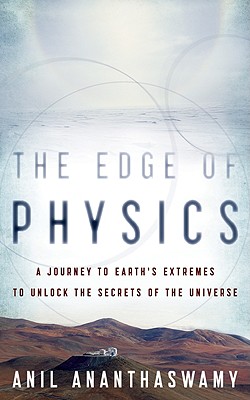
Book review "The Edge of Physics" by Anil Ananthaswamy


 The Edge of Physics: A Journey to Earth's Extremes to Unlock the Secrets of the Universe
By Anil Ananthaswamy
Mariner Books (January 14, 2011)

In "The Edge of Physics", Ananthaswamy takes the reader on a trip to some of the presently most exciting experiments in physics. The Soudan Mine where physicists are looking for direct detection of dark matter, the Baikal Lake with its underwater neutrino detectors, the Square Kilometre Array in South Africa, the VLT in Chile, the IceCube Neutrino Observatory at the South Pole, and others more before he finishes his travels at CERN in Geneva.
Along this trip one learns a lot not only about the scenery, but also about physics and the history of physics. Ananthaswamy doesn't add the experiments as an afterthought to elaborations on quantum mechanics and special relativity, but the experiments and the people working on them take lead. His theoretical explanations are brief but to the point. The appendix contains the shortest summaries of the Standard Model and the Concordance Model that I've ever seen. He explains enough so the reader can understand which new physics the experiments are looking for and what the relevance is, but always quickly comes back to show how this search proceeds in reality.

I found this book hugely enjoyable because it is not your typical popular science book. I didn't have to make my way through yet another chapter that promises to explain general relativity without equations, and I learned quite some things along the way. It's amazing how many details experimentalists have to think about that would never have occurred to me. Ananthaswamy tells stories of people who found their destiny, stories of courage, stories of trial and error, and some quite dramatic accidents and almost accidents. It's a very well written narrative.

I have only one complaint about this book which is that it would have very much benefited from some illustrations, be that to explain the CMB power spectrum, the generations and families in the Standard Model, the thermal history of the universe, or sketches of the experiments and their parts.

In summary, I can recommend this book to everybody with an interest in contemporary physics or the history of physics. If you have no clue about particle physics or cosmology whatsoever, you might not be able to follow some of the explanations, which are really brief. But even then you'll still take something away from this book. I'd give "The Edge of Physics" 5 out of 5 stars.

Consequences of using the journal impact factor

An interesting paper that should be mandatory literature for everybody making decisions on grant or job application, especially for those people impressed by high profile journals on publication lists:
    Deep Impact: Unintended consequences of journal rank
    Björn Brembs, Marcus Munafò
    arXiv:1301.3748 [cs.DL]
It's a literature review that sends a clear message about the journal impact factor. The authors argue the impact factor is useless in the best case and harmful to science in the worst case.

The annually updated Thomson Reuters journal impact factor (IF) is, in principle, the number of citations to articles in a journal divided by the number of all articles in that journal. In practice, there is some ambiguity about what counts as "article" that is subject of negotiation with Thomson Reuters. For example, journals that publish editorials will not want them to count among the articles because they get rarely cited in the scientific literature. Unfortunately, this freedom in negotiation results in a lack of transparency that casts doubt on the objectivity of the IF. While I knew that, the problem seems to be worse than I thought. Brembs and Munafò quote some findings:
"For instance, the numerator and denominator values for Current Biology in 2002 and 2003 indicate that while the number of citations remained relatively constant, the number of published articles dropped...
In an attempt to test the accuracy of the ranking of some of their journals by IF, Rockefeller University Press purchased access to the citation data of their journals and some competitors. They found numerous discrepancies between the data they received and the published rankings, sometimes leading to differences of up to 19% [86]. When asked to explain this discrepancy, Thomson Reuters replied that they routinely use several different databases and had accidentally sent Rockefeller University Press the wrong one. Despite this, a second database sent also did not match the published records. This is only one of a number reported errors and inconsistencies [87,88]."
(For references in this and the following quotes, please see Brembs and Munafò's paper.)

That is already a bad starting point. But more interesting is that, even though there are surveys confirming that the IF captures quite well researcher's perception of high impact, if one looks at the numbers, it actually doesn't tell much about the promise of articles in these journals:

"[J]ournal rank is a measurable, but unexpectedly weak predictor of future citations [26,55–59]... The data presented in a recent analysis of the development of [the] correlations between journal rank and future citations over the period from 1902-2009 reveal[s that]... the coefficient of determination between journal rank and citations was always in the range of ~0.1 to 0.3 (i.e., very low)."
And that is despite there being reasons to expect a correlation because high profile journals put some effort into publicizing articles and you can expect people to cite high IF journals just to polish their reference list. However,
"The only measure of citation count that does correlate strongly with journal rank (negatively) is the number of articles without any citations at all [63], supporting the argument that fewer articles in high-ranking journals go unread...

Even the assumption that selectivity might confer a citation advantage is challenged by evidence that, in the citation analysis by Google Scholar, only the most highly selective journals such as Nature and Science come out ahead over unselective preprint repositories such as ArXiv and RePEc (Research Papers in Economics) [64]."
So IFs of journals in publication lists don't tell you much. That scores as useless, but what's the harm? Well, there are some indications that studies published in high IF journals are less reliable, ie more likely to contain exaggerated claims and cannot later be reproduced.
"There are several converging lines of evidence which indicate that publications in high ranking journals are not only more likely to be fraudulent than articles in lower ranking journals, but also more likely to present discoveries which are less reliable (i.e., are inflated, or cannot subsequently be replicated).

Some of the sociological mechanisms behind these correlations have been documented, such as pressure to publish (preferably positive results in high-ranking journals), leading to the potential for decreased ethical standards [51] and increased publication bias in highly competitive fields [16]. The general increase in competitiveness, and the precariousness of scientific careers [52], may also lead to an increased publication bias across the sciences [53]. This evidence supports earlier propositions about social pressure being a major factor driving misconduct and publication bias [54], eventually culminating in retractions in the most extreme cases."
The "decline effect" (effects getting less pronounced in replications) and the problems with reproducability of published research findings have recently gotten quite some attention. The consequences for science that Brembs and Munafò warn of are
"It is conceivable that, for the last few decades, research institutions world-wide may have been hiring and promoting scientists who excel at marketing their work to top journals, but who are not necessarily equally good at conducting their research. Conversely, these institutions may have purged excellent scientists from their ranks, whose marketing skills did not meet institutional requirements. If this interpretation of the data is correct, we now have a generation of excellent marketers (possibly, but not necessarily also excellent scientists) as the leading figures of the scientific enterprise, constituting another potentially major contributing factor to the rise in retractions. This generation is now in charge of training the next generation of scientists, with all the foreseeable consequences for the reliability of scientific publications in the future."
Or, as I like to put it, you really have to be careful what secondary critera (publications in journals with high impact factor) you use to substitute for the primary goal (good science). If you use the wrong criteria you'll not only not reach an optimal configuration, but make it increasingly harder to ever get there because you're changing the background on which you're optimizing (selecting for people with non-optimal strategies).

It should clearly give us something to think that even Gordon Macomber, the new head of Thomson Reuters, warns of depending on publication and citation statistics.

Misconceptions about the Anthropic Principle

I keep coming across statements about the anthropic principle leaving its mark on physics that strike me as ill-informed, most recently in a book I am presently reading “The Edge of Physics” by Anil Ananthaswamy:
“The anthropic principle – the idea that our universe has the properties it does because we are here to say so and that if it were any different, we wouldn’t be around commenting on it – infuriates many physicists, including [Marc Davis from UC Berkeley]. It smacks of defeatism, as if we were acknowledging that we could not explain the universe from first principles. It also appears unscientific. For how do you verify the multiverse? Moreover, the anthropic principle is a tautology. “I think this explanation is ridiculous. Anthropic principle… bah,” said Davis. “I’m hoping they are wrong [about the multiverse] and that there is a better explanation.””
The anthropic principle has been employed in physics as a proposed explanation for the values of parameters in our theories. I’m no fan of the anthropic principle because I don’t think it will lead to big insights. But it’s neither useless nor a tautology nor does it acknowledge that the universe can’t be explained from first principles.
  1. The anthropic principle doesn’t necessarily have something to do with the multiverse.

    The anthropic principle is true regardless of whether there is a multiverse or not and regardless of what fundamentally is the correct explanation for the values of parameters in our theories. The reason it is often mentioned in combination with the multiverse is that proponents of the multiverse argue it is the only explanation, and no further explanation is needed or necessary to look for.

  2. The anthropic principle most likely cannot explain the values of all parameters in our theories.

    There are a lot of arguments floating around that go like this: If the value of parameter x was just a little larger or smaller we’d be fucked. The problem with these arguments is that small variations around one out of two dozen parameters leave out most possible combinations of parameters. You’d really have to consider modifications of all parameters together to be able to conclude there is only one supportive of life, which is however not a presently feasible calculation. And though this calculation is not feasible, the claim that there is really only one combination of parameters that will create a universe hospitable to life is on shaky ground already because this paper put forward a universe that seems capable of creating life and yet is entirely different from our own. And Don Page had something to say about this too.

    The anthropic principle might however still work for some parameters if their effect is almost independent on what the other parameters do.

  3. The anthropic principle is trivial, but that doesn’t mean it’s useless.

    Mathematical theorems, lemmas and corollaries are results of derivations following from assumptions and definitions. They essentially are the assumptions, just expressed differently, always true and sometimes trivial. But often, they are surprising and far from obvious, though that is inevitably a subjective statement. Complaining that something is trivial is like saying “It’s just sound waves” and referring to everything from engine noise to Mozart.

    And so, while the anthropic principle might strike you as somewhat silly and trivially true, it can be useful for example to rule out values of certain parameters of our theories can have. The most prominent example is probably the cosmological constant which, if it was too large, wouldn’t allow the formation of structures large enough to support life. This is not an empty conclusion. It’s akin to me seeing you drive to work by car every morning and concluding you must be old enough to have a driver’s license. (You might just be stubbornly disobeying laws, but the universe can’t do that.) Though, this probably doesn’t work for all parameters, see 2.
  4. The anthropic principle does not imply a causal relation.

    Though “because” suggests so there’s no causation in the anthropic principle. An everyday example for “because” not implying an actual cause: I know you’re sick because you’ve got a cough and a runny nose. This doesn’t mean the runny nose caused you to be sick. Instead, it was probably some virus. Alas, you can carry a virus without showing symptoms so it’s not like the virus is the actual “cause” of my knowing. Likewise, that there is somebody here to observe the universe did not cause a life-friendly universe into existence. (And the return, that a life-friendly universe caused our existence isn’t the case because life-friendly doesn’t mean interested in science, see 3. Besides this, it’s not like the life-friendly universe sat somewhere out there and then decided to come into existence to produce some humans.)
  5. The applications of the anthropic principle in physics have actually nothing to do with life.

    As Lee Smolin likes to point out, the mentioning of “life” in the anthropic principle is entirely superfluous verbal baggage (my words, not his). Physicists don’t usually have a lot of business with the science of self-aware conscious beings. They talk about formation of large scale structures or atoms. Don’t even expect large molecules. However, talking about “life” is arguably catchier.

  6. The anthropic principle is not a tautology in the rhetorical sense.

    It does not use different words to say the same thing: A universe might be hospitable to life and yet life might not feel like coming to the party, or none of that life might ever ask a why-question. In other words, getting the parameters right is a necessary but not a sufficient condition for the evolution of intelligent life. The rhetorically tautological version would be “Since you are here asking why the universe is hospitable to life, life must have evolved in that universe that now asks why the universe is hospitable to life.” Which you can easily identify as rhetorical tautology because now it sounds entirely stupid.
  7. It’s not a new or unique application.

    Anthropic-type arguments, based on the observation that there exists somebody in this universe capable of making an observation, are not only used to explain free parameters in our theories. They sometimes appear as “physical” requirements. For example: we assume there are no negative energies because otherwise the vacuum would be unstable and we wouldn’t be here to worry about it. And requirements like locality, separation of scales, and well-defined initial value problems are essentially based on the observation that otherwise we wouldn’t be able to do any science, if there was anybody to do anything at all.

Hurdles for women in physics

Time Magazine's Person of the Year in 2012 was Barack Obama, the dullest choice they could possibly have made. I would have cast my vote for Malala Yousafzai who made it on the list of runners-up. Among the runners-up one could also find particle physicist Fabiola Gianotti ("The Discoverer") who had the eyes of the world on her when she announced the discovery of the Higgs last year. That, I thought, was pretty cool to find a particle physicist on that list.Alas, the article, if you read it, is somewhat funny. To begin with you might get the impression she was selected for heroically fighting a toothache. And then there is this remark:
“Physics is a male-dominated field, and the assumption is that a woman has to overcome hurdles and face down biases that men don’t. But that just isn’t so. Women in physics are familiar with this misconception and acknowledge it mostly with jokes.”
This pissed me off enough to write a letter to the editor. I only learned coincidentally the other day that it appeared in the Jan 21 issue of the US edition. (Needless to say, we get the European edition.) Below is the full comment I wrote and the shortened version that appeared. There are many other things one could have mentioned, but I wanted to keep it brief.
“As a particle physicist, it was exhilarating for me to see Fabiola Gianotti on your list of runners-up, but I was very dismayed by Kluger's statement it is a "misconception" that women in physics face hurdles men don't.

Yes, instances in which I have been mistaken by my male colleagues for the secretary or catering personnel can be "acknowledge[d] mostly with jokes", though these incidences arguably reveal biases and not everybody finds them amusing. But the assertion that women in physics do not "have to overcome hurdles... that men don't" speaks past the reality of academia and is no laughing matter.

In this field the competition for tenure usually plays out in the mid to late thirties, and is not only accompanied by hard work but also frequently by international moves. Men can postpone their family planing until after they have secured positions. Women can't. I am very lucky to live in a country with generous parental leave and family benefits. But I do have female colleagues in other countries who faced severe problems because of unrealistic expectations on their work-performance and lack of governmental support while raising small children.

Both genders face the tension between having a family and securing tenure, but the timing is markedly more difficult for women. You have done a great disservice to female physicists by denying this "hurdle" exists.”